Category: Balkan Detox

  • Wildlife Crime Academy

    Wildlife Crime Academy

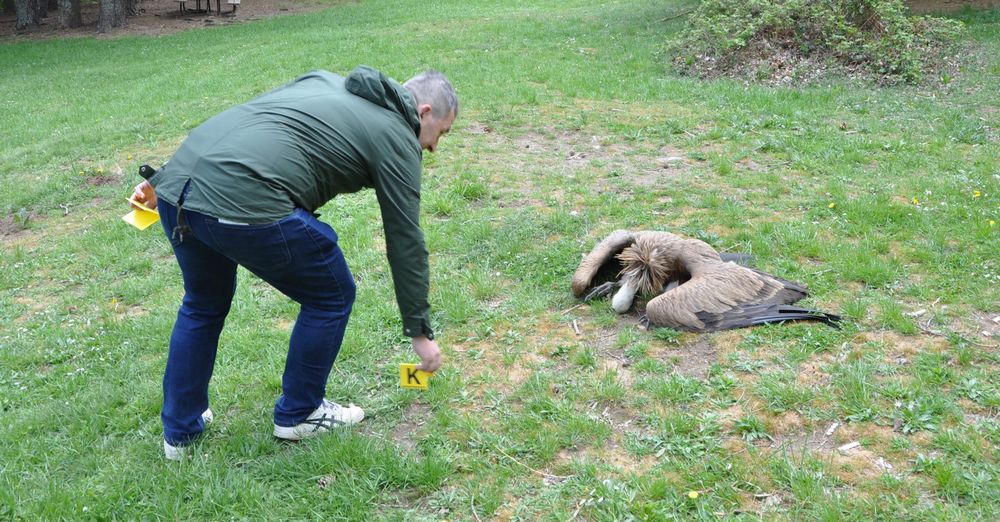
    In Andalusia, Spain, they even use helicopters to investigate suspicious bird mortality. An action that might seem unreal for other countries, but it’s actually just a tool and not the most important aspect in solving wildlife crime. What really matters in criminal investigations are the human resources, capacities and real engagement from the competent authorities.

    Spain is leading the way when it comes to fighting wildlife crime. In the Balkans, it’s a different story, but there is hope. First of all, there has been some progress made over the past few years, especially in Bulgaria and Greece. Secondly, in exactly one week, the first Wildlife Crime Academy (WCA) course will commence in the hope to transfer Spanish expertise and raise capacities to the Balkans and beyond.
    The problem of wildlife crime in the Balkans

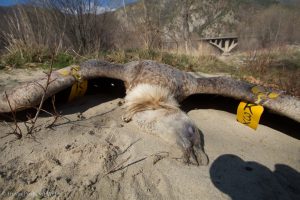
    Currently, capacities and law enforcement related to wildlife crime hold very low priority in most Balkan countries, so there are almost no convictions or minimal sentences executed. This means that wildlife criminals, such as people who place poison baits targeting animals, go unpunished, and continue their illegal activities with no consequences. The BalkanDetox LIFE project aims to make a change. For the past three years, the Vulture Conservation Foundation (VCF) has worked intensively alongside local NGOs and government authorities in Balkans on this issue through the Balkan Anti-Poisoning Project. Through this project, we identified the relevant representatives, prepared national road maps and established national working groups for anti-poison actions. This experience allows the BalkanDetox LIFE project to carry out the necessary awareness activities to position wildlife crime as a priority, and also organise the Wildlife Crime Academy, which is just around the corner!

    First course of the Wildlife Crime Academy

    Next Tuesday on 29 June 2021, conservation, police, toxicology and veterinary professionals from nine countries will come together in Cazorla, Spain, to attend the Wildlife Crime Academy’s BASIC level training. Wildlife crime specialists who amassed over 15 years of experience in the field across Europe developed the courses with the overarching goal to convert participants into experts of wildlife crime forensic and police investigation. When participants complete all three levels of the WCA over the coming years, they will be able to investigate wildlife crime from the early action and CSI to the final procedure at the Court. Overall, the Academy will reinforce operational capacities and coordinate institutional actions to increase detection and improve management of poisoning incidents, facilitate an immediate and effective response to such incidents as well as strengthen enforcement to deter criminal activities. Furthermore, WCA graduates will also become ambassadors, spreading awareness about the importance of tackling wildlife crime and implementing national courses for their courses to enhance impact.

    As part of BalkanDetox LIFE, the Vulture Conservation Foundation will coordinate the Wildlife Crime Academy, which relies on the support of the Regional Government of Andalusia (Junta de Andalucía) and the Spanish Ministry for the Ecological Transition and the Demographic Challenge (Ministerio para la Transición Ecológica y el Reto Demográfico).
  • The BalkanDetox LIFE Project Team Finally Met in Person

    The BalkanDetox LIFE Project Team Finally Met in Person

    The BalkanDetox LIFE Project Team Finally Met in Person: 1st NEEMO Monitor Visit and 2nd Partnership Meeting

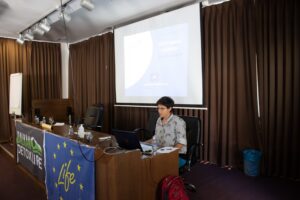
    The Project Team of the BalkanDetox LIFE project welcomed the opportunity to meet in person for the first time since the project officially started back in October 2020. During the meeting, the partners discussed and evaluated the overall implementation progress, analyzed the achievements and milestones reached so far and set a course of action for the next six months of the project. Additionally, we used this opportunity to carry out the 1st official NEEMO monitoring visit to our project.

    First face-to-face event since COVID-19

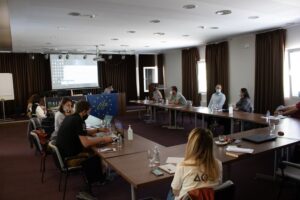
    The Vulture Conservation Foundation (VCF) organized the meeting in Veles, North Macedonia, between 17-19 May, where members from AOS, PPNEA, BIOM, FWFF, MES and BPSSS attended in person. The VCF invested a lot of effort in the implementation of all COVID-19 precautionary measures, according to the official safety recommendations issued by the authorities in the Republic of North Macedonia, which were well respected by all meeting participants. This being the first face-to-face meeting that we were organizing, and participating in, since the pandemic started, we thought it would be best to limit the participation to only the crucial technical and financial staff from the project team. For non-attending members of the team, a virtual connection was provided, giving them the opportunity to actively follow the course of the meeting and take part in the discussions.

    “Being able to meet the team and our monitor in person for the first time since the project started gave us the opportunity to catch up and talk into detail about the progress on each action we started implanting so far. I believe that we all saw how these face-to-face meetings were much more useful and productive, especially when planning for the future.”

    Uroš Pantović, Project Coordinator of BalkanDetox LIFE

    Project progress and upcoming actions

    The meeting focused on three main aspects of the project: technical, financial and management implementation and communication work. During the technical sessions, our NEEMO monitor and all the participants had the opportunity to get informed in detail about the progress that each project partner had made during the first six months of implementing the project in their respective country, as well as all the difficulties and ongoing issues associated with the implementation of current actions. Additionally, the project team has set implementation priorities for the next six months to come and has discussed all the potential difficulties that might occur in the different countries of the project. 

    The financial session focused on conducting the financial checks by the external monitoring team of NEEMO and presenting the financial progress report from the first six months of the project. We had the opportunity to discuss and sort out all financial issues with our monitor and the financial team of the Coordinating beneficiary.

    The communication session provided an overview of the progress made so far, which included key deliverables, including the project website and visual identity. It further provided an outline for actions foreseen in the coming months, which include a digital campaign to raise awareness about the project and the problem of illegal poisoning in the Balkans. All participants were happy with the results.

    “It was necessary to see all these motivated people in person and realise one more time how great the BalkanDetox LIFE team is. With this  meeting we proved two things: safe meetings during the pandemic are feasible and meetings in person are crucial for the good implementation of this project.”

    Jovan Andevski, VCF’s Programmes Manager
  • Sunchica returns after spending the winter in the Middle East

    Sunchica returns after spending the winter in the Middle East

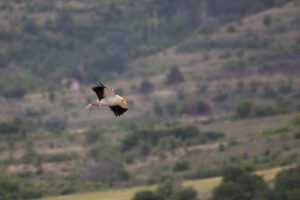
    We are excited to inform you all that the far-travelling Sunchica is back in the Balkans after flying around the Middle East for the past 5 months!

    Sunchica’s journey

    Back in 2019 the Fund for Wild Fauna and Flora (FWFF) tagged Sunchica as well as several other Griffon Vultures, with GPS tags in Greece and North Macedonia. The Macedonian Ecological Society was part of this effort in tagging with hopes to track poisoning incidents in the Balkans which continues to bring vulture population counts to devastating lows. Sunchica’s travels have been exciting to monitor with the vulture embarking on an impressive trip which brought her all the way to the Middle East. Although she’s had a successful journey, things weren’t always optimistic for the young vulture.

    In the beginning of October 2019, Sunchica was found in Berovo hungry, exhausted, and unable to fly. Animal protection association Pro-Anima Berovo called us to help with the vultures’ rescue. Sunchica was then taken to the Skopje Zoo where she was looked after and rehabilitated. By the end of October, the vulture was released by us in Vitachevo from where she began to fly east. Unfortunately, by mid-November she was detected to be in trouble and was captured near Lake Vistonida in Greece. Once again, she was found in an exhausted s

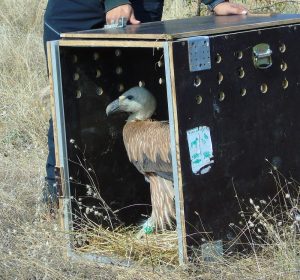
    Sunchica, seconds before being released

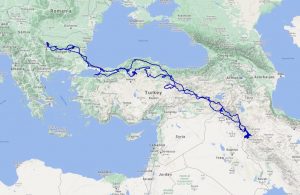
    tate due to her inability to find food. After being transported to a vet center in Thessaloniki, she made a recovery and was released again at Dadia in December 2019! Up until October 2020 she had been circling around the Eastern Rhodopes and Central Balkan. Sunchica then began to fly east towards the Black Sea and following the coast. Crossing Turkey and Iraq, she reached Iran by late November. Now, after 6 months, Sunchica has returned to the Balkans and can be seen flying through the skies of western Bulgaria!

    Since October 2020 Sunchica has been recorded to have flown 18,732 km! Her starting position and the area where she spent most of winter-time extends to a distance of 2,800 km. This trip is even more impressive considering that it is the young vulture’s first long-distance journey!

    This tracking is made possible thanks to the ongoing monitoring of tagged vultures within the new EU-funded BalkanDetox LIFE project  which we are a part of. The project aims to raise awareness and strengthen national capacities in an e

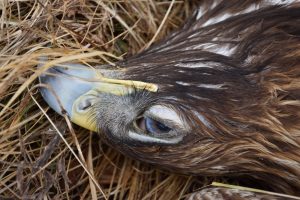
    ffort to fight the problem of illegal wildlife poisoning in the Balkans, which is responsible for the population declines of numerous threatened and endangered species. The project also has a new logo which attempts to illustrate the severity of illegal wildlife poisoning using the poisoned skull while providing hope since the poison is draining — therefore, signifying our goal to detox the Balkans from this severe threat.

    Project logo


  • A successful Kick-off Meeting of the newly launched LIFE project BalkanDetox LIFE

    A successful Kick-off Meeting of the newly launched LIFE project BalkanDetox LIFE

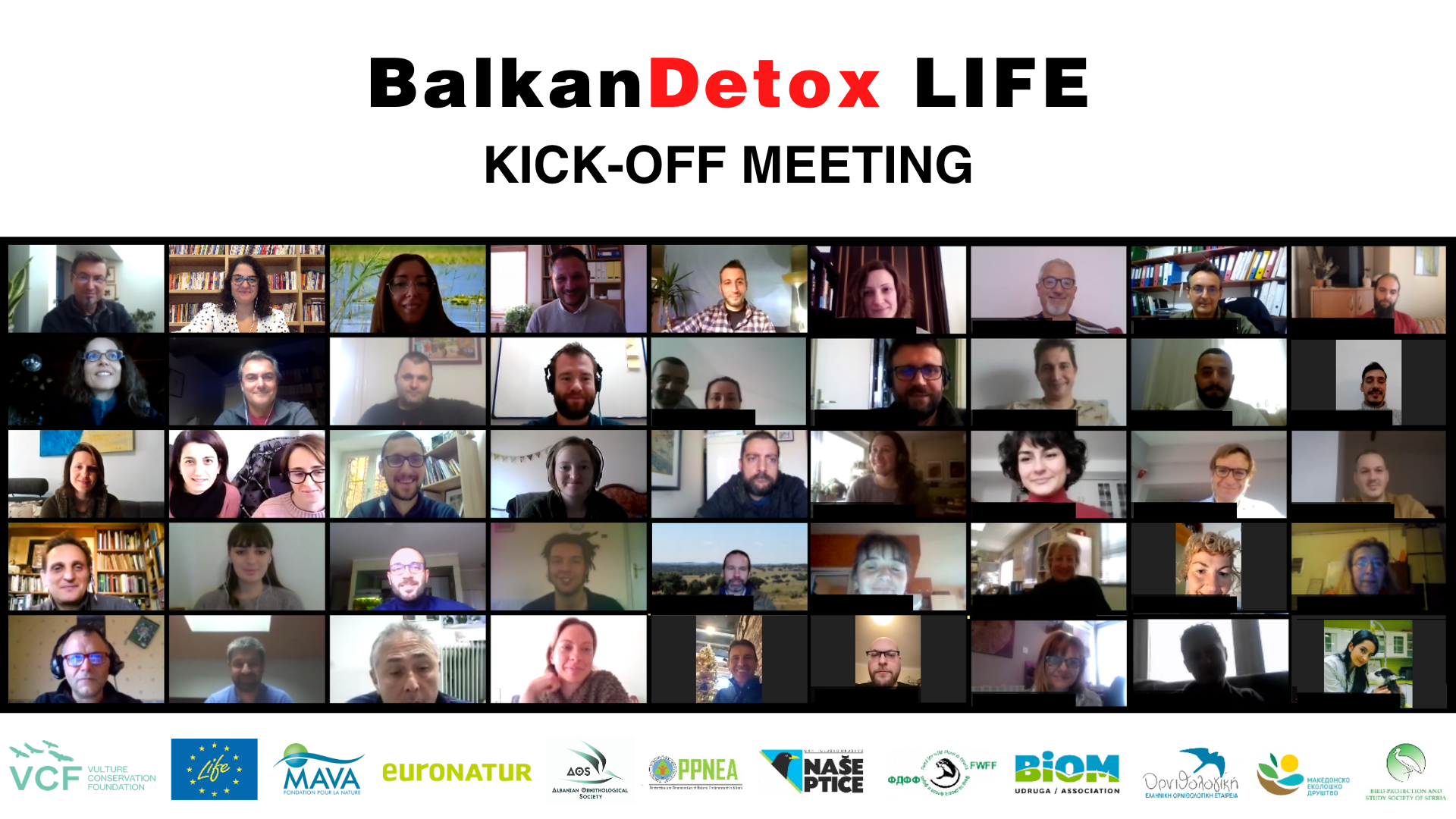
    Even though partners and stakeholders could not meet in person for the BalkanDetox LIFE Kick-off Meeting due to the COVID-19 restrictions, we are glad to report that the meeting was a success nonetheless, and received a lot of interest and engagement by multiple relevant stakeholders!

    Overview of Kick-off Meeting

    On Monday, 30 November 2020, the BalkanDetox LIFE Kick-off Meeting brought together the nine project partners with many important stakeholders spread across the Balkans and other corners of the world to discuss the project scope, objectives, timeline, and everything in between. During the meeting, we started the initial discussions towards the establishment of the official working groups in each of the relevant Balkan countries, which is crucial to secure institutional cooperation and support for combating this illegal practice, as NGOs cannot fight this problem alone.
    The meeting had over 110 registrations and the highest number of participants present at a time was 80, although people joined and left depending on the sessions. Overall, the meeting was a success, making new connections, exchanging expertise and experiences, and reinforcing collaboration among key stakeholders to combat the most severe threat to vultures in the region — illegal wildlife poisoning!

    Project actions planned for 2021

    The Kick-off Meeting laid the foundations for a successful project — now what’s next for BalkanDetox LIFE? The project team has many ambitious plans for 2021, but these are continually adjusted and modified due to the ongoing pandemic.

    One of the most significant actions for next year are the meetings with relevant institutions in Albania, Bosnia and Herzegovina, Croatia, Greece, Republic of North Macedonia and Serbia to start the development of national standard operational protocols in the investigation of poisoning incidents.
    Furthermore, other meetings will be held relating to the development and adoption of National Anti-Poisoning Road Maps and the investigation of the scope of misuse and origin of legal and illegal toxic substances used for wildlife poisoning. Partners will host tailored educational workshops in local communities, where wildlife poisoning remains a prominent issue, to address the drivers behind poison use in each project country and also promote the use of preventive measures that are safe for animals and the environment.

    Last but not least, the first Wildlife Crime Academy training in Spain with staff from NGOs and governmental authorities from the Balkans is foreseen to take place next spring. The training aims to reinforce institutional capacities and prosecution efficacy towards better management of poisoning incidents through the adoption of Spanish best practice experience.

    To stay tuned with project news, make sure to follow the dedicated Facebook page of BalkanDetox LIFE.

  • BalkanDetox LIFE: New project combats illegal wildlife poisoning across Balkan countries

    BalkanDetox LIFE: New project combats illegal wildlife poisoning across Balkan countries

    Launch of EU-funded project raises awareness and strengthens national capacities to fight the problem of wildlife poisoning in the Balkans, which is one of the most important causes of mortality and population decline for numerous threatened and endangered species.

    Even though wildlife poisoning is illegal in the Balkans, this harmful practice is still widespread and poses a real threat to wildlife, especially vultures, the environment and public health. Thanks to conservation actions, there has been a lot of progress made, and now, the launch of an ambitious project brings new hope for further combating this problem! Through the ‘BalkanDetox LIFE’ project, nine organizations will work alongside various national and international stakeholders, ranging from government authorities to hunters and livestock breeders, to minimize this threat and achieve concrete results across seven Balkan countries.

    The BalkanDetox LIFE project was built on the good grounds made by the Vulture Conservation Foundation’s (VCF), Balkan Anti-Poisoning Project, especially in securing engagement of relevant governmental institutions for combating wildlife poisoning, and will enable the continuation of this initiative to improve management of poisoning incidents and achieve significant reduction of mortality of vultures and other affected species caused by this illegal practice in the region“, says Uroš Pantović from the and Project Coordinator of BalkanDetox LIFE.
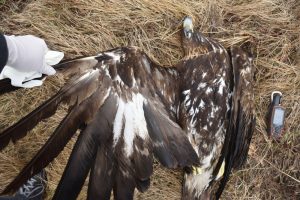
    The most common type of wildlife poisoning in the Balkans is the intentional placement of poison baits to kill wild predators or other feral and domestic animals that may inflict damage on livestock or game species. In addition to the animals targeted, other vulnerable species suffer too as it is a non-selective means of extirpating animals. Vultures as being mostly obligate scavengers often fall victim to poisoning, either by directly consuming the bait or feeding on the carcasses of poisoned animals. The frequent and successive poisoning incidents in the Balkans resulted in 465 confirmed vulture deaths over the past 20 years, and a VCF study estimates that at least 115 vultures die annually from poisoning in the Balkans since only about 20% of such incidents are discovered and documented.

    This alarming problem has caused severe depletion and even extinction of vultures species in Balkan countries, where populations are still very low and fragmented, and it is urgent to tackle the issue if we are to restore them to former levels and distribution. Vultures, also known as nature’s cleanup crew, remove rotting carcasses from the wild, helping to keep ecosystems healthy as they act as natural carcass recyclers and providing important environmental services for free that benefit nature, wildlife and society as a whole!“, says José Tavares, Director of the VCF.

    The BalkanDetox LIFE project aims to shift the behaviour and perceptions of the multiple stakeholders, from the decision-makers to the general public and the actual users of poison baits. The project team will raise awareness about the severity of wildlife poisoning as well as advise on safe alternatives to the root-problem (human-wildlife conflict), such as preventative measures that do not harm animals or the environment. Furthermore, it will reinforce operational capacities and coordinate institutional actions to increase detection and improve management of poisoning incidents, facilitate an immediate and effective response to such incidents as well as strengthen enforcement to deter them. The final aim is to minimize the scale and scope of wildlife poisoning in the Balkans, and therefore helping safeguard nature and people!

    Illegal wildlife poisoning is an environmental crime, and as such we need an adequate involvement of authorities to register, investigate and punish these activities. This project will work alongside government enforcement agencies to achieve just that”, says Jovan Andevski, VCF’s Conservation Programmes Manager.

    The ‘BalkanDetox LIFE’ project is a five-year endeavour with a €1.8 million budget, which received funding from the EU’s LIFE Programme, and it is co-financed by the VCF, the MAVA Foundation and Euronatur, as well as by the Whitley Fund for Nature and Environmental Protection and Energy Efficiency Fund for specific actions, and will be implemented across Albania, Bosnia & Herzegovina, Bulgaria, Croatia, Greece, North Macedonia and Serbia. Project partners are the Vulture Conservation Foundation as the coordinating beneficiary, and the Albanian Ornithological Society, Association BIOM, Bird Protection and Study Society of Serbia, Fund for Wild Flora and Fauna, Hellenic Ornithological Society, Macedonian Ecological Society, Ornitološko društvo NAŠE Ptice and the Protection and Preservation of Natural Environment in Albania. Furthermore, this project is based on Spanish best practice experience and counts on the support from Junta de Andalucía and the Ministry for the Ecological Transition and the Demographic Challenge.