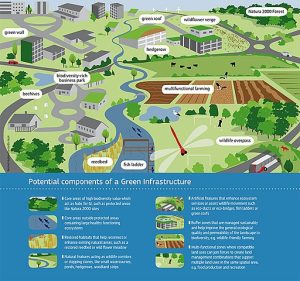
 Green Infrastructure is a strategically planned network of natural and semi-natural areas. Green Infrastructure (GI) plans the use of space in a way that protects nature and decreases the fragmentation of natural areas. Although areas are protected with measures of protection, Grean Infrastructure is mindful of their connection. GI takes into account the different elements that are important for the functioning of a green area – from the free flow of water and resources, to the free movement of animals. The protection of an area is insufficient if outside of the area of protection infrastructure projects are built that prevent the flow of water and the movement of animals. This type of fragmentation is one of the biggest threats to the protection of the environment.
The concept of Green Infrastructure is connected to the concept of ecosystem services – the benefits that people get from nature. Functional ecosystems offer a wide array of benefits. For instance, forests create clean air and clean water, offer protection from floods, mitigate the effects of climate change, etc. But, in order for people to be able to use the benefits from ecosystems, the ecosystems have to be healthy. This is why Green Infrastructure is important.
In Green Infrastructure, natural ecosystems are considered to be infrastructure that offer benefits to people in a spatial, economic, and recreational sense, and precisely because of that they need to be protected. In addition to Green Infrastructure, there is also grey infrastructure, which encompasses all types of human made infrastructure, such as roads, dams, pipes, etc. Gray infrastructure is a road itself, whereas Green Infrastructure entails, for example, it being built with permeable materials to let rainwater pass, surrounded by vegetation that absorbs water, which prevents floods. Green bridges allow animals a safe passage across roads, and therefore the ability to move over a larger territory. A dam that is built under the principles of Green Infrastructure does not destroy the river ecosystem. Green Infrastructure is mindful that grey infrastructure does not destroy the benefits we already receive from nature.
Green Infrastructure can be applied for different goals – from the conservation of already protected areas, to the connection of fragmented areas, to the restoration of degraded ecosystems, in rural and urban settings. In cities, Green Infrastructure can take different forms: green roofs on buildings, parks, as well as beekeeping.
In short, Green Infrastructure does not simply mean “green space”. Green Infrastructure means the integral planning of space in a way that protects nature and the benefits we get from it.

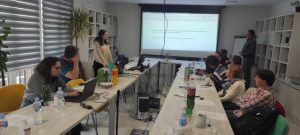
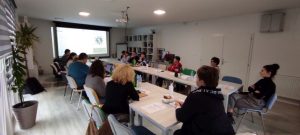
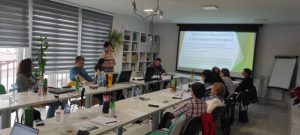
 Proper planning of space and land use is essential for the maintenance and development of Green Infrastructure (GI) and all its benefits. In order to promote the concept of GI and to see how it is incorporated and implemented in our national and in EU legislation, we held the first training for GI with key stakeholders connected to spatial planning and nature protection. The participants in this training were representatives from the Ministry of Environment – Department of Spatial Planning and department of Nature Conservation, PE National Roads, Faculty of Architecture, Faculty of Forest Sciences, Faculty of Natural Sciences and Mathematics, as well as consulting companies and NGOs that work in the field of environment protection and spatial planning (Farmahem, Maneko, and Ursus Telea).