 From the 14th to the 16th of March 2022, MES participated in a workshop for the monitoring and supervision of the lindane and HCH remediation at OHIS, organized by the Ministry of Environment and Physical Planning/POPs Unit, in collaboration with the United Nations Industrial Development Organization (UNIDO), and the international company TAUW from the Netherlands.
The workshop consisted of two days of theoretical training for the sustainable management, monitoring, and supervision of the remediation activities in OHIS, and one day practical training on location in OHIS.
The training was conducted by TAUW, a Dutch company with expertise on dealing with POPs (persistent organic pollutants) which, as an external company, is in charge of overseeing the whole process of the removal of lindane from the small landfill in OHIS. The main topics of the workshop were an introduction to the Stockholm convention, contaminated site management, remediation management, health and safety management and monitoring, and monitoring and supervision of a remediation.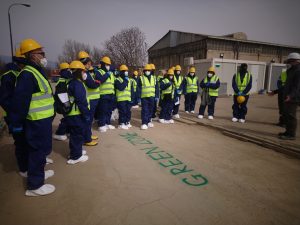
TAUW started with a brief history of OHIS, as well as the main objectives of the project and the specific work plan. As background knowledge, TAUW also covered the history of POPs around the world, showcasing that dealing with toxic waste of this type is still a major problem. They introduced the Stockholm convention – an international agreement aimed at eliminating or reducing the production and use of POPs.
The training was detailed, and throughout the two days it took the participants step by step through the major topics regarding the management of a project of this type and the management of a contaminated location, from researching the site through available information and through direct on-site research, to possible contracts, necessary safety equipment and machinery, budget planning, correct zoning and manner of moving between zones, to monitoring of safety, analysis of soil and groundwater, etc.
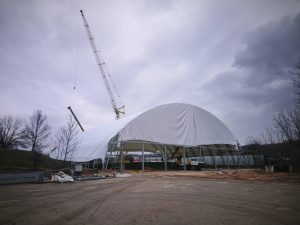
On the second day, a representative of the contractor POLYECO gave a presentation on their operative plan and the current state in OHIS. POLYECO showed that the safety tent has been set up, complete with three tunnels – one for employees, one for the necessary machinery, and one with rails that will be used for the containers with lindane and contaminated soil to go in and out. They showed how the space in the factory is divided by zones and how the activities will be conducted in accordance with the zoning, which safety equipment the employees will use, and which safety measures will be followed. They showed the already set up systems for the monitoring of air, and the water filters which will be used in the process itself, as well as the containers that will be used for the transportation of the lindane and the contaminated soil.
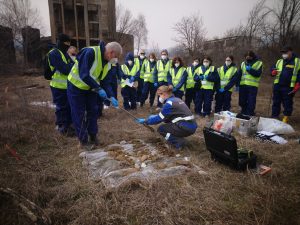
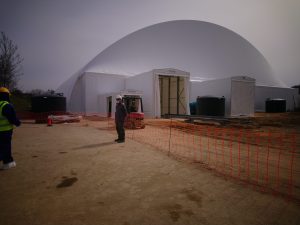 The third day was dedicated to conducting direct field activities in OHIS – the participants were provided with safety equipment and trained to excavate soil and conduct soil and contamination analysis. With instruction and equipment from TAUW, the participants learned how to excavate and analyse soil. Using an X-ray device on the spot, they determined how much mercury and other elements were present in the excavated soil, and documented all of this in work forms. After this training, POLYECO conducted an informative tour through OHIS, in the part where the preparation activities, packing and removal of lindane (from the small landfill) will be performed. The participants entered the yellow zone, where the containers for the transportation of lindane, HCH, and contaminated soil were located. The yellow zone came up to the tent (which was set up in the red zone) where the three tunnels could be seen, but the participants did not enter in the tent itself. In the yellow zone there was also a decontamination unit – a special part with two chambers where employees can shower and leave their contaminated equipment in the first chamber, and then change into clean clothes in the second chamber.
As a part of the workshop, the trainers shared useful materials from the field. At the end of the workshop MES, together with the other participants, received a certificate for monitoring and supervision of the remediation at OHIS.

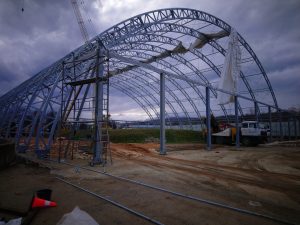 In the next phase, the impenetrability of the tent material will be tested, which is necessary for achieving the conditions needed for negative pressure, which in turn is needed for the minimization of the emission of dust and contaminated material during the implementation of the operational activities.